Monday, January 15, 2007

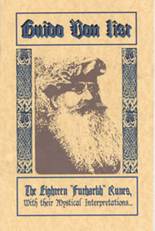
The Life of Rune Master Guido von List


Early Years (1848-1869)

Guido Karl Anton List was born in Vienna on 5 October 1848 to Karl August and Maria List (nee Killian). His father was a fairly prosperous dealer in leather goods, and we can assume that Guido's early life was lived in comfortable and nurturing surroundings. The List family was Catholic, and we also presume that Guido was trained in that confession.
From the start of adolescence we have evidence of some of his propensities in life. He was fascinated by the landscape of his native Lower Austria and by the cityscape of his native city, Vienna . His sketchbook - which has drawings from as far back as 1863 (when he would have been fifteen years old) - demonstrates his interest in such sites. Some of these sketches were later used to illustrate the Deutsch-mythologische Landschaftsbilder (German Mythological Landscape Scenes, published 1891.). In conjunction with the romanticising of his environment, young Guido, by his own account, also had developed a strong mysto-magical bent of no orthodox variety.
'It was in the year 1862 - I was then in my fourteenth year of life - when I, after much asking, received permission from my father to accompany him and his party who were planning to visit the catacombs [under St. Stephen's Cathedral in Vienna] which were at that time still in their original condition. We climbed down, and everything I saw and felt excited me with a kind of power that today I am no longer able to experience. Then we came - it was, if I remember correctly, in the third or fourth level - to a ruined altar. The guide said that we were now situated beneath the old post office (today the Wohlzeile House No. 8). At that point my excitement was raised to fever pitch, and before this altar I proclaimed out loud this ceremonial vow: "Whenever I get big, I will build a Temple to Wotan!" I was, of course, laughed at, as a few members of the party said that a child did not belong in such a place… I knew nothing more about Wuotan than that which I had read about him in Vollmer's Woterbuch der Mythologie. '
Despite these artistic and mystical leanings, Guido was expected, as the eldest child, to follow in his father's footsteps as a businessman. He appears to have fulfilled his responsibilities in a dutiful manner, but he took any and all opportunities to develop his more intense interests.

The Mystical Wanderer (1870-1877)

The many trips that List was obliged to make for business purposes afforded him the opportunity to indulge himself in his passion for hiking and mountaineering. This activity seems to have provided a matrix for his early mysticism.

Although descriptions of List's early pilgrimages into nature exist, it is unclear what underlying mystical tradition he was familiar with at the time. Two things are obvious, however: he was possessed of the idea of the sacredness of his native land, and he has an "All-Mother." The interest in his native soil was probably spurred by his early passion for Germanic myth and lore.
At one point, one of his mountain adventures almost claimed List's life. As he was climbing a mountain on 8 May 1871 , a mass of ice gave way under his feet and he fell some distance. He was apparently saved only by the fact that he had landed on a soft surface covered by a recent snowfall. In memory of his good luck List had a track equipped with a chain put up. This was opened on 21 June 1871 and was named after him: the Guido-List-Steig.
Apparently List recorded his mystical wanderings in nature in verbal descriptions as well as in sketches. In 1871, his writing talents were given vent as he became a correspondent of the Neue deutsche Al-penzeitung (New German Alpine Newspaper), later called the Salonblatt. He also began to edit the yearbook of the Osterreicher Alpenverein' (Austrian Alpine Association), whose secretary he had become that year.
List often went in the company of others on his journeys into the mountains, which were taken on foot, by wagon, horse, or rowboat; but he would usually strike out on his own at some point to seek the solitude of nature.
Besides gaining general mystical impressions in these outings, List also engaged in active celebratory ritual work. He would perform various rituals that sometimes seemed quite impromptu. The most famous depiction of such an event is his celebration of the summer solstice on 24 June 1875 at the ruins of the Roman City of Carnuntum. For this - as for so much else - we are dependent on List's own somewhat fictionalised account, first published in Vienna in 1881. Basically, the ritual elements of this outing included the arduous task of gaining access to the so-called Heidentor ("Heathen Gate") of the city (which List mystically identified as the gate from which a German army set out to conquer Rome in 375 C.E.), the drinking of ritual toasts to the memory of the local spirit ( genius loci ) and the heroes of the past, the lighting of a solstice fire, and the laying of eight wine bottles in the shape of the "fyrfos" (Swastika) in the glowing embers of the fire. List and his company then awaited the dawn.
These early experiences were sometimes later more completely fictionalised, as, for example, in his visionary tale "Eine Zaubernacht" (A Night of Magic). In this account, the persona (List) succeeds in invoking from the great mound a divine seeress ( Hechsa ) who reveals to him that he is not to be the liberator of the Germans - but that despite this "the German folk has need of the skald."

The Folkish Journalist (1877-1887)

This rather comfortable, if self-divided, period in List's life came to an end after his father died in 1877, when List was twenty-nine years old. Neither he nor his mother appear to have had the elder List's keen sense of business, and as economic times became difficult List quit the business to devout himself fulltime to his writing. At this time his writing continued to be of a journalistic kind. Deprived of his ability to travel and wander as he had before, he wrote articles for newspapers, such as the Neue Welt, Neue deutsche Alpenzeitung, Heimat, and the Deutsche Zeitung, which dealt with his earlier travels and mystical reflections on these Loci. Many of these pieces were anthologised in 1891 in his famous Deutsch-mythologische Landschaftbilder. It was also during this period, in 1878, that he married his first wife, Helene Foster-Peters. However, the marriage was not to last through the difficult years of this period.
Given the Pan-German nationalism of the various groups and papers with which List had been associated throughout his career, it seems certain that from a political standpoint he was firmly in their camp.
However, the nature of his mysticism at this time seems to have been somewhat more original. Before any influence from later Theosophical notions could have been present, he was continuing on the path of mystical Germanic revivalism. Besides his own intuition - which, given his results, must have been his chief source - he must have been familiar with a variety of non-scientific, neo-romantic works on Germanic mythology and religion popular at the time, and was perhaps also aware of at least a portion of the scientific studies. In any event, many of the uniquely Listian notions seem to have been already solidifying in this early period.
Through these years, List was also working on his first book-length (two-volume) effort, Carnuntum, a historical novel based on his vision of the Kulturkampf between the Germanic and Roman worlds centred at that location around the year 375 C.E.

The Nationalist Poet (1888-1899)

Carnuntum was published in 1888 and became a huge success, especially among the Pan-German nationalists of Austria and Germany . Its publication brought its author more to the attention of important political and economic leaders of German nationalist movements. In connection with the appearance of Carnuntum, List made the acquaintance of the industrialist Friedrich Wannieck. This association was to prove essential to List's future development.
Throughout this period, List devoted himself to the production of further neo-romanticism prose, such as Jung Diethers Heimkehr (Young Diether's Homecoming) and Pipara, in 1894 and 1895 respectively. The anthology of earlier journalism Deutsch-mythologische Landschaftbilder was published in 1891, and List developed his writing skills in poetic and dramatic genres as well.
List became involved with two important literary associations during these years. In May 1891, the Iduna, bearing the descriptive subtitle "Free German Society for Literature," was founded by a circle of writers around Fritz Lemmermayer. Lemmermayer acted as a sort of "middle man" between an older generation of authors (which included Fercher von Steinwand, Joseph Tandler, Auguste Hyrtl, Ludwig von Mertens, and Josephone von Knorr) and a group of younger writers and thinkers (which included Rudolf Steiner, Marie Eugenie delle Grazie, and Karl Maria Heidt). The name Iduna, which was provided by List himself, is that of a North Germanic goddess of eternal youth and renewal. Within the society were two other authors with specifically neo-Germanic leanings: Richard von Kralik and Joseph Kalasanz Poestion. This literary circle was loosely held together by neo-romantic ideas of German nationalism, a sense of "turning within one's self" ( innerliche Wanderung ), antirealism, and anti-decadence. The society was only able to last until 1893, when the dilettantism of the various interests seems to have become too acute. However, in many ways this does seem to have been the springtime of the neo-Germanic movement. Another neo-romantic literary association, the Literarische Donaugesellschaft (Danubian Literary Society), was founded by List and Fanny Wschiansky the year the Iduna was dissolved.
It is almost certain that List and Rudolf Steiner knew each other in the early 1890's, since both were being influenced by the first wave of Theosophy and occult revivalism in German-speaking countries at that time. However, there is little chance that either one had too much direct influence on the other. Each of them would become more "Theosophical" in the next decade. List also met the young Jorg Lanz von Liebenfels (Adolf Joseph) at this time as well but it would not be until after Lanz had left the Heiligenkreuz monastery in 1899 that any extensive interaction between the two was possible.
By far the most important influence on List's development at this time were those provided by the nationalist and Pan-German cultural and political groups whose attention had been drawn to him by the publication of Carnuntum. These were largely associations of people of German ancestry and language in the multiethnic Austrian Empire, whose aims included the promotion of Germanic culture and language and the eventual political union of Austrian Germans with the greater German Empire to the west, that is, Germany proper.
Of course such notions were common enough at the time, and List was certainly already firmly in this camp before 1891. Even the "sporting” associations in which he had earlier begun to be active had Pan-German political aims. However, this period began a more activist phase for List, who had, up until this time, been fairly exclusively "mystical" in his approach. The new phase brought List into close contact with such leading political figures as Georg von Schonerer, a Pan-German member of the Imperial Parliament, and the powerful publicist and parliamentary deputy Karl Wolf. Both of these men also published newspapers, and List's work appeared in Wolf's Ostdeutsche Rundschau (East German Review) on a regular basis. It might also be speculated that List had as much a "mystifying" effect on the political world as it had a "politicising" effect on his views. This trend would continue with the later advent of the New Templar Jorg Lanz von Liebenfels. But it was List's association with the Wannieck family and their organisation and publishing house, Verein "Deutsche Haus" ("German House" Association), which was to prove most important to List. They published many of his books in this decade and give him a wider outlet for his ideas. In 1892 he delivered a lecture on the ancient Germanic cult of Wuotan to the Verein Deutsche Geschichte (German History Association). Numerous other associations allied with this one proliferated in Austria at this time. Another groupBund der Germanen (Germanic League), sponsored the performance of List's mythological dramatic poem, Der Wala Erweckung (The Wala's Awakening), in 1894. In another performance of this drama in 1895, which was attended by over three thousand people, the part of Wala was read by Anna Wittek, a young actress who later became List's second wife.
Through these years, List became a well-known and respected artist and mystagogue among Austrian German nationalists, and he was to remain a part of the conservative cultural establishment throughout his life.

The Emerging Master (1898-1902)

The time between the publication of Der Unbenesiegbare (1898), List's neo-Germanic catechism, and the year 1902 marked a period of transformation of List from someone known primarily as an artist to an occult investigator, religious leader, and prophet of a coming age.
Concerning the generation of the manuscript for Der Unbenesiegbare there is a story that perhaps demonstrates the growing - if ambivalent – association between mysticism and politics in these circles. In the summer of 1898, a law prescribing religious instruction in Lower Austria secondary schools was being debated. Dr. Karl Lueger, who was later to become the mayor of Vienna and a member of the Guido von List Society, was for the bill, as were the church officials. When he was questioned on this by representative Karl Wolf, Lueger responded “Gebt uns Besseres und wir warden Euch folgen!” (Give us something better and we shall follow you!). It is said that List was deeply moved by this and wrote Der Unbenesiegbare overnight. List took the manuscript to Wolf's office the next day, but the whole idea was eventually rejected by Wolf, as his interests in religion were “just matters of curriculum.” The catechism was printed in an edition of five thousand copies, marking the beginning of List's more practical religious career.
Perhaps the successes he had had with the poetic drama Der Wala Erwechung spurred List to try his hand at more drama, because in the last phase of his conventional literary career this genre predominated. However, to assume that List intended these dramas as mere entertainment would be a mistake. He saw them more as Weihespiele (sacral plays) which had a liturgical as well as didactic purpose. In 1900, he published a pamphlet, Der Wiederaufbau von Carnuntum (The Reconstruction of Carnuntum), in which he called for the establishment of ritual dramas and legal assemblies based on ancient Germanic models.
In August 1899, List married Anna Wittek von Stecky, who had sung the Wala parting his play in 1895. They were married in a Lutheran church – which is also some indication of the decay of the Catholic establishment and general religious dissatisfaction in Austria at that time.
This period acts more as a sort of bridge between List's long artistic phase and his shorter, but highly intense and influential, mystico-magical phase from 1902 to his death in 1919. It is also most likely that during this period (1898-1902) Theosophical ideas as such became more influential in List's worldview. After all, it was not until 1897-1901 that the German translation of The Secret Doctrine by H.P. Blavatsky appeared. Certainly List would have had Theosophical ideas available to him long before this (perhaps as early as the 1880's), but the evidence of a general lack of Theosophical concepts in Der Unbenesiegbare would indicate that it was of little influence before 1898.

In 1902, by his own accounts, there resulted in his “revelations” concerning the 'Secret of the Runes.'

The Occult Master (1902-1919)

Late in 1902, List had undergone an operation for cataracts. For eleven months his eyes were bandaged, and in this virtual state of blindness and utter darkness List is said to have been enlightened with regard to the “secret of the runes.” At this time, and by whatever means, List's occult vision did seem to undergo a major synthesis. That the main features of his thought were solidified in this period is witnessed by the fact that he produced his first manuscript on Kala and published an article on his interpretation of glyphs (swastika, triskelion, etc.) in 1903.
Between this time and 1908, when Das Geheimnis der Runen was published and the Guido-von-List-Gesellschaft (Guido von List Society) was founded, List's ideas probably underwent their final synthesis. After 1908, it seems “occult wisdom” flowed freely and constantly from the pen of the Master.
It was between 1903 and 1907 that List first began to use the noble title “von” in his name. Legitimate or not, it was important for List to distance himself from his middle-class background as his ideas took on a more aristocratic tone – and began to appeal more and more to the aristocratic establishment.
On 2 March 1908 the Guido von List Society was officially founded to support the work of the Master.
Although chiefly founded by the Wannieck family, it was also supported by many leading figures in Austrian and German politics, publishing, and occultism.
All of List's occult research works that were to be published in his lifetime were originally published between 1908 and 1914. Economic restrictions after that time put an end to the production of original works.
The Guido von List society remained the exoteric outlet for List's ideas, mainly in the form of his multivolume “research findings.” However, his work implied a deeper, more practical level as well. For the expression of this aspect, in the form of a magical order or lodge, the Hoher Armanen-Orden (High Armanic Order), HAO, was founded in midsummer 1911. Thus List had formed exoteric and esoteric circles in his organisation. The activities of the esoteric HAO were indeed mysterious. We know that they conducted pilgrimages to what they considered holy Armanic sites, Saint Stephen's Cathederal in Vienna , Carnuntum , etc. They also had their occasional meetings between 1911 and 1918, but the exact nature of these remains unknown. The HAO never really crystallised in List's lifetime - although it seems possible that he developed a theoretical body of unpublished documents and rituals relevant to the HAO which have only been put into full practice in more recent years.
An odd chapter in Guido von List's story was opened in November 1911 when he received a letter from a mysterious figure in Germany calling himself Tarnhari. This man turned out to be one Ernst Lautner, who claimed to be a descendant of the ancient Nordic tribe of the Wolsungen (Old Norse Volsungar, the tribe to which Sigurd/Siegfried belonged). He also claimed, however, to be a reincarnation of a chieftain of this tribe. Lautner was also to be instrumental in the spread of List's ideas in Germany . Unfortunately, for the Von List’s legacy, Lautner’s close association with such figures as Dietrich Eckart would ultimately lead to von List’s ideas becoming corrupted and absorbed into the extreme right political movements that spring up in Germany, following the end of the First World war. This was not, however, something that von List would live to see
Throughout the years of World War 1, although nothing new was published by the Master, his reputation and fame grew, and his ideas were becoming more popular than ever. But the war took its toll on the health of the now elderly List. Within a few months after the end of the war,

List died while on a visit to his followers in Berlin , on 17 May 1919 . His body was cremated and placed in an urn in his native Vienna . - Victor Ordell L. Kasen

Monday, December 25, 2006

The Teutons and how they view their gods


The way in which the Aryan peoples view and have viewed their gods over the millenia is radically different to that of other peoples, most notably the semitic peoples.
A study of the ancient literature of the Germanic, Celtic, Greek and Roman peoples gives us a glimpse, albeit a distorted one of how our ancestors thought of the gods and related to them.
The great problem with the later Germanic literature, ie the Eddas and sagas is that they have been compiled by christian scribes who too often have had an agenda in portraying our gods in a particular way. Therefore we must be careful as to how we interpret the literture and keep in mind that often it will have a christian gloss or that the gods may be portrayed in ways that can open them to ridicule, blasphemy or censure.
Two works however are largely free of misinterpretation on religious grounds, ie Tacitus `Germania`, composed in 97CE and Julius Caesar`s `de Bello Gallico` from the first century BCE.
However even with these works we have to understand that the Roman writers would have had their own prejudices concerning the Germanic peoples who they regarded as barbarians.
The Teutons of the later pre-christian age[round about the end of the first millenium CE] appeared to think of their gods in human terms, the gods having a human form, albeit with incredible powers. At the time of Tacitus and Caesar it would appear that they thought of their gods in more elemental ways.

"As for gods, Mercury is the one they worship most, and on certain days they think it right to propitiate him even with human victims.
Hercules and Mars they appease with lawful animals. Part of the Suebi sacrifice also to Isis; I have not ascertained the source from which this foreign rite originates, but the fact remains that the image itself, fashioned in the form of a light ship, proves that the cult is imported.
In other matters, they judge it not in accord with the greatness of the gods to confine them with walls or to liken them in appearance to any human countenance. They consecrate woods and groves, and the mystery they see only in their awe they call by the names of gods."
[Germania 9.1 and 9.2]

This idea is brought out much more strongly by the earlier work by Caesar:

"The customs of the Germans are very different from those of the Gauls. They have no druids to preside over religious matters, nor do they concern themselves with sacrifices. The only things which they do count as gods are things they can see and which clearly benefit them, for example, the Sun, Vulcan, and the Moon. They have not even heard rumours of any others."
[The Gallic War, 6.21]

It should be noted that where Tacitus and Caesar speak of `Mars, Hercules, Isis` etc that these are the Romans` own names for the Teutons` gods which are known by different names.
The ancient Teutons viewed themselves as children of the gods and their royal dynasties in particular counted their descent from them, especially from the god Woden/Odin/Wotan.
They claimed a certain equality with the gods:

"As a complete man with his honour unsullied, the honest Indo-European stands upright before his God or Gods. No reliosity which takes something away from man, to make him appear smaller before a deity who has become all-powerful and oppressive, is Indo-European."
[Chapter 2 of `Religious Attitudes of the Indo-Europeans` by Hans FK Guenther]

The Teutons like the other Aryan peoples had no rigid dogmas or doctrines or even a recognised priesthood for much of their history. However the later literture indicates that by the coming of christianity in Scandinavia the northern Teutons did have quite elaborate temples, rites and a priesthood.

"All Indo-European forms of belief, so long as they maintained the pure, traditional Nordic spirit, have remained free from any rigid doctrine of belief or dogma and from the worship of a revealed word. Hence it follows that under the original Indo-Europeans there arose no teachers to instruct the people in their beliefs, no theologians, and no priesthhod holier and more elevated than the rest of the people.
The Brahmanism of the Aryan Indians like the Druidism of the Celts, is an exception among the priesthoods of the Indo-European peoples, but it only developed as such over the course of the centuries, reflecting alien admixtures, customs and influences."
[Chapter 5 of `Religious Attitudes of the Indo-Europeans` by Hans FK Guenther]

Present day Germanic heathens tend by and large to think of their gods as `archetypes` that are present in the racial Collective Unconscious. This is how Carl Gustav Jung described the emergence of Wotan in the late 19th and early 20th centuries in the Germanic lands, especially the German speaking countries.

"A mind that is still childish thinks of the gods as metaphysical entities existing in their own right, or else regards them as playful or supersticious inventions. From either point of view the parallel between Wotan redivivus and the social, political, and psychic storm that is shaking Germany might have at least the value of a parable. But since the gods are without doubt personifications of psychic forces, to reassert their metaphysical existence is as much an intellectual presumption as the opinion that they could ever be invented. Not that "psychic forces" have anything to do with the conscious mind, fond as we are of playing with the idea that consciousness and psyche are identical. This is only another piece of intellectual presumption. "Psychic forces" have far more to do with the realm of the unconscious."
["Wotan"[1936] by CG Jung]

Modern heathens as well as conceiving the gods as archetypes of the Collective Unconscious also consider the gods to be encoded in our DNA and passed down from generation to generation.

"The dual nature in which the Gods affect our lives is through the personal bonds we forge with them, affecting us in a personal way by shaping our personalities. The other way is rooted in the genetic, collective group we belong to. We are members of an ethnic group or nation-a folk. Each of us has a personal and group destiny. The former is the course that our individual lives take, the latter are how the fate of the group we belong to, affects us. The Gods reside within, in our blood, genes or DNA. This link also bonds us together as a people. It is the life-force of the folk. What we do as individuals will affect the Gods, but what we do collectively as a folk, will have a profound effect on the Gods."
[Chapter 2 of `The Book of Balder Rising` by Robert Blumetti]

Sunday, December 17, 2006

Pagan Resurrection by Richard Rudgley


Amazon Review


Synopsis

"Pagan Resurrection" puts forward a fascinating and controversial idea - namely that it is the pagan god Odin and not Christ who is the single most important spiritual influence in western civilisation. Far from being just a New Age fad, paganism is fast becoming a major spiritual, intellectual, ecological and political force across the globe. Rudgely is an Oxford trained anthropologist and critically acclaimed author of "Lost Civilisations of the Stone Age", who has since presented three series on Channel 4. He takes the reader through the strange world of modern pagan cuts, the pagan beliefs that underpin important parts of modern culture, such as "Lord of the Rings" and the highly pagan counter culture that sprang up in the sixties and now offers an attractive alternative spiritual vision to millions alienated from Christianity. He explains the ancient idea of the Web - a cosmic field of energies that encompasses time, space and the hidden potentials of the human organism, and shows that this is a pagan equivalent to the eastern tradition of Tao. Our civilisation, our belief systems and attitudes indeed our psyche have been formed by Odin. The influence of Christ, he says, has been relatively recent and shallow. Paganism, like Christianity, can be a force for good or evil. At this turning point in history we need to choose between the dark and destructive paganism that gave rise to Nazism and modern right-wing movements in American and, on he other hand, the green paganism of ecology and alternative spirituality. Every decade or so a new generation is inspired by a controversial classic of alternative history/spirituality - The Holy Blood and the Holy Grail, Fingerprints of the Gods... The time now is just right for Pagan Resurrection!

From the Publisher
Controversial study of the rise of paganism suggesting that the pagan god Odin and not Christ is the single most important spiritual influence in western civilisation


From the Inside Flap
Pagan Resurrection is the biography of a god. The old pagan deity Odin, dethroned by Christ, has rised again to play a powerful role in human affairs in the modern era.

The pagan myths and gods are ancient blueprints that are still very much alive in the modern mind, influencing both thought and action. The author explores this revival in its various manifestations - from Victorian science-fiction, to the proto-hippies of early twentieth century Germany, from the Nazis to the ideas of the psychologist Carl Jung.

After the Second World War, paganism spread across the English-speaking world. Its diverse power and influence can be found in the writings of Tolkien, the hippie movement of the sixties, the actions of serial killers in the US, in neo-Nazi terrorism, and in occult circles.

The new paganism is an increasing power in modern culture not only in Europe and America but across the globe. It has manifested in both creative and destructive ways and, if the positive an conscious power of the Odin myth is drawn upon, then our civilisation can be transformed for the better. The new paganism provides a living philosophy for the twenty-first century. Pagan Resurrection is not just about the modern crisis in western spirituality, it also suggests a way forward

About the Author
Richard Rudgley:
Richard Rudgley was born in 1961. He completed a BA in Social Anthropology and Religious Studies and went on to do a M. St. and M. Phil. in Ethnology and Museum Ethnography at Oxford. He is currently doing a D. Phil. and specialising in historical and contemporary uses of psychoactive substances by the native peoples of Canada and Alaska. He has done much field work in China and Canada, and written and lectured on the usage of hallucinogens and intoxicants. He is married and lives in London.

Friday, November 17, 2006

The Mythical Origins of the Germanic Peoples


Viktor Rydberg in his `Teutonic Mythology` states that "The human race, or at least the Teutonic race, springs, according to the myth, from a single pair, and has accordingly had a centre from which their descendants have spead over that world which was embraced by the Teutonic horizon."
He goes on to relate how the story of the creation of the first Teutonic man and woman from trees[Ask and Embla-ash and elm] has its origins in Aryan creation myth. The first humans were plants before they became human.
Odin, Vili and Ve[or Odin, Hoenir and Lodir] gave them breath, soul and intelligence. They transformed these `tree` humans into god men. No doubt the `tree` is symbolic of non-intelligent existence. The gods made man a thinking and creative being.
It is significant that the first Teutons were cited as dwelling upon the seashore. From this particular location their descendants branched out. But where was the seashore to be located?
There is a vital clue to be found in the myth of Scef, the pregenitor of the Anglo-Saxon and related Germanic peoples.
"One day it came to pass that a ship was seen sailing near the coast of Scedeland or Scani, and it approached the land without being propelled either by oars or sails. The ship came to the seabeach, and there was seen lying in it a little boy, who was sleeping with his head on a sheaf of grain, surrounded by treasures and tools, by glaives and coats of mail. The boat itself was stately and beautifully decorated. Who he was and whence he came nobody had any idea, but the little boy was received as if he had been a kinsman, and he received the most constant and tender care. As he came with a sheaf of grain to their country the people called him Scef, Sceaf.
[The Beowulf poem calls him Scyld, son of Sceaf, and gives Scyld the son Beowulf, which was originally another name of Scyld.]"[`Teutonic Mythology]
The Danish royal family according to Beowulf were descended from Scef through his son Scyld]Skjold.
He was a dininely born patriarch and according to Matthaeus Westmonast Scef ruled in Angeln.
The Anglo-Saxon chronicles indicate that the dynasty of Wessex came from Saxony and their progenitor was Scef.
Teutonic man therefore according to his own creation myths was conceived on the shores of the German Ocean or the North Sea in the area of Angeln in southern Scandinavia. From there all the Germanic peoples migrated south and gave birth to the modern Germanic nations of northern Europe.

Sunday, November 5, 2006

Dragon Slaying Myths and Cosmic Order


Joyce Tally Lionarons in "The Medieval Dragon. The Nature of the Beast in Germanic Literature" aserts that "the Indo-European dragon myth is essentially concerned with the establishment of cosmic order and/or legitimating a prevailing cosmic regime."
This can be seen in the battles between Beowulf and the monster Grendel and Grendel`s equally monstrous mother and Beowulf`s final battle with the dragon.
The struggle between Grendel and Grendel`s mother can be interpreted as a struggle for mastery over those forces who opposed the ruling regime. Perhaps the Grendel monster is a metaphor for the very real human forces that opposed the reign of Hygelac? Perhaps Hygelac was a recent interloper as the origin myth of the arrival of the orphan Scyld Scefing in the opening verses of the Beowulf poem indicates? Quite possibly Grendel and his mother represented a displaced royal dynasty.
History and indeed even the contemporary world is replete with examples of the demonisation of political and military enemies. I am positing the theory that Grendel was just such a `demonisation` of a very human enemy. The fact that Grendel has no previous pedigree within Germanic myth and appears solely in this particular poem seems to reinforce this idea.
Lionarons makes the valid observation that Grendel is pictured as an `anti-king` who reigns over Hygelac`s hall of Heorot during the nightime hours. Grendel`s mere is also viewed as a type of `anti-hall`. Whilst Grendel could be viewed as the `host` of Heorot during the night hours Beowulf likewise is the unwelcome and hostile `guest`. In turn Grendel can also be viewed as the unwelcome guest whilst Hygelac or his champion, Beowulf is the host.
The author explains that the Old English word gaest can be interpreted as `guest`, `ghost` or `stranger`. The word is compounded in various places of the poem to indicate the notion of an unfriendly, an unwelcome or hostile guest, eg waelgast[murderous guest], inwitgaest[malicious guest] and nidgaest[hostile guest].
The shifting roles of host and guest as evidenced in the battles initiated in Heorot by first Grendel and then his mother and in the final conflict between Beowulf and Grendel`s mother in the mere. Beowulf and the monsters exchange the roles of host and guest, all in a struggle for mastery and the maintenance or creation of a new order.
Beowulf`s encounter with the dragon occurs at the end of his life when a dragon ravages Beowulf`s kingdom. The dragon represents a threat to the social order established in Beowulf`s kingdom. The dragon or monster representing the `anti-hero` is fated to lose the encounter whilst the hero must inevitably encounter and defeat the anti-hero to either establish or maintain his power and authority. Beowulf on all three occasions succeeds in his struggles against his adversaries although in the last encounter it costs him his life.
Even Grendel`s mother`s role as the avenger is typical of pre-christian Germanic society with the notion of the blood feud. In short the monsters depicted in `Beowulf` are reminiscent of human adversaries demonised by the reigning and victorious political elite.
Is there a lesson in this for us today in 2006?

Monday, October 16, 2006

The Rigsthula or Germanic Caste System


Within the sacred works of the myths of the Germanic peoples there is a myth of the caste system.
This is to be found in the Rigsthula.
The Rigsthula tells the story of how the Germanic god Rig came to earth and visited three couples who were childless. He stayed three days with each and begets a child on the wife of each of the three couples.
Here is the story:-


"Once walked, 'tis said, the green ways along, mighty and ancient, a god most glorious; strong and vigorous, striding, Rig.
Ever on he went in the middle of the way, till he came to a house with door unclosed. He entered straight; there was fire on the floor and a hoary couple sitting by the hearth, Great-grandfather and mother in ancient guise.
Well knew Rig how to give them counsel, he sat him down in the middle of the floor, with the home-folk twain upon either side.
Great-grandmother fetched a coarse-baked loaf, all heavy and thick and crammed with husk: she bore it forth in the middle of the dish, with broth in a bowl, and laid the board.
Thence Rig uprose, prepared to rest; -- well he knew how to give them counsel -- he laid him down in the middle of the bed and the home-folk twain upon either side. Thus he tarried three nights together, then on he strode in the middle of the road while thrice three moons were gliding by.
Great-grandmother bore a swarthy boy; with water they sprinkled him, called him Thrall. Forthwith he grew and well he throve, Bur tough were his hands with wrinkled skin, with knuckles knotty and fingers thick; his face was ugly, his back was humpy, his heels were long. Straightway 'gan he to prove his strength, with bast a-binding loads a-making, he bore home faggots the livelong day.
There came to the dwellings a wandering maid, with wayworn feet, and sunburned arms, with down-bent nose,- the Bond-maid named.
She sat her down in the middle of the floor; beside her sat the son of the house: they chatted and whispered, their bed preparing -- Thrall and Bond-maid -- the long day through.
Joyous lived they and reared their children. Thus they called them: Brawler, Cowherd, Boor and Horsefly, Lewd and Lustful, Stout and Stumpy, Sluggard, Swarthy, Lout and Leggy. They fashioned fences, they dunged the meadows, swine they herded, goats they tended and turf they dug.
Daughters were there, -- Loggy and Cloggy, Lumpy-leggy, and Eagle-nose, Whiner, Bondwoman, Oaken-peggy, Tatter-coat and the Crane-shanked maid. Thence ate come the generations of thralls.The Birth of Churl
Ever on went Rig the straight roads along till he came to a dwelling with door unclosed; he entered straight; there was fire in the floor; Grandfather and Grandmother owned the house.
The home-folk sat there hard a-working; by them stood on the floor a box; hewed the husband wood for a warp-beam; trim his beard and the locks o'er his brow, but mean and scanty the shirt he wore.
The wife sat by him plying her distaff, swaying her arms to weave the cloth, with snood on her head and smock on her breast, studs on her shoulders, and scarf on her neck.
Well knew Rig how to give them counsel; he sat him down in the middle of the floor, and the home-folk twain upon either side.
Grandmother set forth plenteous dishes; cooked was the calf, of dainties best. Thence Rig uprose prepared to rest. -- Well he knew how to give them counsel -- he laid him down in the middle of the bed and the home-folk twain upon either side.
Thus he tarried three nights together, then on he strode in the middle of the road while thrice three moons were gliding by.
A child had Grandmother, Churl they called him, and sprinkled with water and swathed in linen, rosy and ruddy, with sparkling eyes. He grew and throve, and forthwith 'gan he to break in oxen, to shape the harrow, to build him houses and barns to raise him, to fashion carts and follow the plough.
Then home they drove with a key-hung maiden in goat-skin kirtle, named Daughter-in-Law. They wed her to Churl in her bridal linen: the twain jade ready, their wealth a-sharing, kept house together, and joyous lived.
Children reared they thus they called them: Youth and Hero, Thane, Smith, Yeoman, Broad-limb, Peasant, Sheaf-beard, Neighbour, Farmer, Speaker and Stubbly-beard.
By other names were the daughters called: Dame, Bride, Lady, Gay, and Gaudy, Maid, Wife, Woman, Bashful, Slender. Thence are come the kindreds of churls.The Birth of Earl
Still on went Rig the straight roads along till he came to a hall whose gates looked south. Pushed was the door to, a ring in the post set: he forthwith entered the rush-strewn room. Each other eyeing, the home-folk sat there -- Father and Mother, -- twirling their fingers. There was the husband, string a-twining, shafting arrows and shaping bows: and there was the wife o'er her fair arms wondering, smoothing her linen, stretching her sleeves. A high-peaked coif and a breast-brooch wore she, trailing robes and a blue-tinged sark. Her brow was brighter, her breast was fairer, her throat was whiter than driven snow.
Well knew Rig how to give them counsel; he sat him down in the middle of the floor, and the home-folk twain upon either side.
Then took Mother a figured cloth, white, of linen, and covered the board; thereafter took she a fine-baked loaf, white of wheat and covered the cloth: next she brought forth plenteous dishes, set with silver, and spread the board with brown-fried bacon and roasted birds. There was wine in a vessel and rich-wrought goblets; they drank and revelled while day went by.
Well knew Rig how to give them counsel; he rose ere long and prepared his couch: he laid him down in the middle of the bed, and the home-folk twain upon either side.
Thus he tarried three nights together; then on he strode in the middle of the road while thrice three moons were gliding by.
Then a boy had Mother; she swathed him in silk, and with water sprinkled him; called him Earl. Light were his locks, and fair his cheeks, flashing his eyes like a serpent's shone.
Grew Earl forthwith in the halls and 'gan to swing the shield, to fit the string, to bend the bow, to shaft the arrow, to hurl the dart, to shake the spear, to ride the horse, to loose the hounds, to draw the sword, and to swim the stream.
Forth from the thicket came Rig a-striding, Rig a-striding, and taught him runes, his own name gave him, -- as son he claimed him, and bade him hold the ancestral fields, -- the ancestral fields -- and the ancient home.
Then on rode Earl through the murky wood, through the rimy fells till he reached a hall. His shaft he shook, his shield he brandished, his steed he galloped, his sword he drew; war he wakened, the field he reddened, the doomed he slew, and won him lands -- till alone he ruled over eighteen halls. Gold he scattered and gave to all men treasures and trinkets and slender-ribbed horses; wealth he strewed and sundered rings.
Along dewy roads his messengers drive till the hall they reached where Ruler dwelt. A daughter owned he, dainty fingered, fair and skilful, Erna called.
They wooed her and brought her home a-driving; to Earl they wed her in veil fine-woven: husband and wife lived happy together, their children waxed and life enjoyed.The Birth of King
Heir was the eldest, Bairn the second, Babe, Successor, Inheritor, Boy, Descendent, Offspring, Son, Youth, Kinsman; Kon the kingly was youngest born.
Forthwith grew up the sons of Earl; games they learned, and sports and swimming, taming horses, round shields bending, war shafts smoothing, ash spears shaking; but King the youngest alone knew runes, runes eternal and runes of life. Yet more he knew, -- how to shelter men, to blunt the sword-edge and calm the sea: he learnt bird language, to quench the fire flame, heal all sorrows and soothe the heart; strength and might of eight he owned.
Then he strove in runes with Rig, the Earl, crafty wiles he used and won, so gained his heritage, held the right thus Rig to be called and runes to know.
Young King rode once through thicket and wood, shooting arrows and slaying birds, till spake a crow, perched lone on a bough: "Why wilt thou thus kill birds, young King? 'Twould fit thee rather to ride on horses, to draw the sword and to slay the foe.
"Dan and Damp have dwellings goodlier, homesteads fairer than ye do hold; and well they know the keel to ride, the sword to prove and wounds to strike."


Rigsthula explains how Rig[or Heimdall as he is elsewhere identified] institutes the Germanic caste system of nobles, peasant-warriors and producers/slaves. This loosely follows the Indo-European or Aryan caste system of priests, nobles/warriors and producers. The Germanic peoples did not have as far as we can tell a seperate priestly caste but it is thought that the priestly and royal functions were combined in the person of the king or chieftain. The Celtic equivalent being Druides, Equites and Plebes. The Roman-Flamines, Milites and Quirites. The Indo-Aryan Brahmas, Ksatriyas and Vaisyas.
Jean Haudry in his book `The Indo-Europeans` states "This society[ie Germanic society] was divided into three classes: the Jarls or nobles; the Karls, free peasants, and the Thralls, servants.. These latter are confined to the servile tasks of the third function. The Karls are peasant soldiers, subordinate in each of their functions to the Jarls; the religious function is not the property of a class, but of one particular Jarl, the king."

The lack of a seperate and distinct religious caste can be explained in terms of a functional shift within the caste system brought about by social upheaval. Is the clue to this upheaval to be found in the the conflict between the Aesir and the Vanir gods, the conflict between the lunar and solar religious systems that was brought about by the ancient movements of the Aryan tribes?

Rudolf Simek in his `Dictionary of Northern Mythology posits the theory that the role of Rig or Hemdall better fits the picture of the wandering god Odin.

By contrast the modern `western` world with its socio-economic `class` system has largely abandoned the notion of a caste that one is born in to and in which one remains and one`s descendants. Instead the rule of the modern age is not blood and descent but money, gold.

Julius Evola has this to say about the function of what he calls the `Doctrine of Castes`:

"The castes, more than defining social groups, defined functions and typical ways of being and acting. The correspondence of the fundamental natural possibilities of the single individual to any of these functions determined his or her belonging to the corresponding caste. Thus, in the duties toward one`s caste[each caste was traditionally required to perform specific duties], the individual was able to recognise the normal explication as well as the development and the chrism of his or her own nature within the overall order imposed "from above". This is why the caste system developed and was applied in the traditional world as a natural, agreeable institution based on something that everybody regarded as obvious, rather than on violence, oppression, or on what in modern terms is referred to as "social injustice". By acknowledging his own nature, traditional man knew his own place, function, and what would be the correct relationship with both superiors and inferiors;...."[Revolt Against the Modern World]

How well does the Bhagavad Gita state

41." O Khrishna, from the predominance of unrighteousness, the women of that family become corrupt; and women being corrupted, there arises intermingling of castes.42. This intermingling of castes leads the destroyers of the family to hell, as also the family itself; for their ancestors fall, being deprived of the offerings of rice ball and water.43. By these misdeeds of the slayers of the family, bringing about confusion of caste, the immemorial religious rites of family and caste are destroyed."
[Bhagavad Gita Chapter 1]


Let us not forget that it is the gods who have ordained the order of castes in recognition of the fact that nature is hierarchical. To overturn this order is to overturn the cosmic order instituted by the gods.

It is the duty of the king to maintain the integrity of the caste system:

"If men persist in seeking intimate contact with other men`s wives, the king should brand them with punshments that inspire terror and banish them.
For that gives rise among people to the confusion of the classes, by means of which irreligion, that cuts away the roots, works for the destruction of everything."
[Laws of Manu, Chapter 8 352-353]


Sunday, October 15, 2006

The Ingvaeones-Ing`s Folk


In Tacitus` Germania 2.2 it says

"In ancient lays, their only type of historical tradition, they celebrate Tuisto, a god brought forth from the earth. They attribute to him a son, Mannus, the source and founder of their people, and to Mannus three sons, from whose names those nearest the Ocean are called Ingvaeones, those in the middle Herminones, and the rest Istvaeones."

The Roman historian Tacitus writing in 97CE categorised the Germanic peoples in to three distinct groups. For the time being we are going to focus on just one of these groups-the Ingvaeones.
So who were the Ingvaeones?
According to Pliny the Ingvaeones included the Cimbri, Teutones and the Chauci, all of which were coastal tribes.
These tribes occupied the Danish and north German coastal areas and it is from this area that the Germanic tribes of the Angles and Jutes joined with the Saxons, Frisians and Franks in their invasion and colonisation of southern Britain, the direct ancestors of the modern English.
John Grigsby in his ground-breaking work, `Beowulf and Grendel` states that "these tribes had been settled in Denmark and northern Germany for at least 2,000 years before Tacitus mentioned them by name." [Chapter 1-`Clans of the Sea Coasts`] .
This would mean that the ancestors of the English had a common cultural and genetic heritage with the Danes.
It is in this area of Old Angeln[Old England] that the poet of the Anglo-Saxon classic `Beowulf` sites the hall of Heorot, the scene of the climatic action between Beowulf and the `monster` Grendel.
The Beowulf poet refers to the `Ingwine` or `friends of Ing`. Hrothgar, the lord of Heorot is referred to as `Lord of the Ingwine`.
Could this mean that the Ingvaeones were descended from the god Ing? Was Ing originally their primary deity? If so then why was he later eclipsed by Woden?

"Ing waes aerest mid Eastdenum
gesewen secgun, oth he siddan est
ofer waeg gewat; waen aefter ran;
thus heardingas thone haele nemdun."

"Ing was amongst the East-Danes first
seen by men, till later east
he went over the wave; his wain followed after;
the Heardings named the hero so."

[Louis J Rodrigues translation from "Anglo-Saxon Verse Runes"]

The rune Ing or Inguz is the 22nd rune of the 3rd aett or the Tyr aett of the Common Germanic Futharc or the Anglo-Saxon Futhorc and represents the god Ing. It is aso associated with the god Frejr and is symbolic of fertility.
Indeed it has been argued that Ing is a manifestation of the
Vanir god of fertility Freyr. Freyr and his sister-wife Freyja are children of the coastal god Njorthr and Nerthus, also a brother-sister fertility pairing.
Ing is associated with the Swedish Yngvi-Freyr which is the name that Snorri gives to the god Frejr in his Ynglinga Saga. The Swedish Yngling kings counted him as their ancestor and founder of the Yngling dynasty.
According to Rudolf Simek Ing`s association with the Gothic name of the yew-rune enguz points to the great age of the god Ing.
Simek states in his "Dictionary of Northern Mythology" "Yngvi could as a result be a derivation from *Ingwia-fraujaz `lord of the Ingaevones` whereby a great age for the construction Yngvi-Freyr must be assumed".
Mr Grigsby argues in `Beowulf and Grendel` that Beowulf was more than just a folk tale but was also based in history and in myth. Whilst there is no direct evidence to support the existence of an historical Beowulf he argues that the story of his killing of Grendel and his mother represents the acting out of an ancient Vanic fertility rite and mystery in the same way the Grail myth is a Celtic representation of this same ancient northern rite.[See his `Warriors of the Wasteland`.]
At the time of the written composition of the Beowulf poem the cult of Odin/Woden/Wotan and the Aesir pantheon had already supplanted the older Vanir gods but the Vanir held out longest in northern Germany and Denmark because of their relative isolation from their more southern Germanic cousins. Being a coastal community the Ingvaeones had a deeper and longer held connection to the Vanir, being gods of the sea and fertility.
Again as before in his earlier work[`Warriors of the Wasteland] he draws a direct connection between the Danish bog sacrifices and the ancient re-enactment of the sacrificial rites of the Old Europeans.
The story of Beowulf`s struggle with Grendel and his mother represents the struggle between the Aesir and the Vanir which is referred to in Snorri`s `Younger Edda` or `Prose Edda` and the Ynglinga Saga.
The worship of the fertility goddess Nerthus singled out these English tribes as being different from their Germanic neighbours.
Tacitus says this of Nerthus:
"There is nothing noteworthy about them individually[ie the Ingvaeones], except that collectively they worship Nerthus, or Mother Earth, and believe that she takes part in human affairs and rides among the peoples.
On an island in the Ocean is a holy grove, and in it a consecrated wagon covered with hangings; to one priest alone is it permitted so much as to touch it. He perceives when the goddess is present in her innermost recess, and with great reverence escorts her as she is drawn along by heifers. Then there are days of rejoicing, and holidays are held wherever she deigns to go and be entertained.
They do not begin wars, they do not take up arms; everything iron is shut away; peace and tranquillity are only then known and only then loved, until again the priest restores to her temple the goddess, sated with the company of mortals.
Then the wagon and hangings, if you will, the goddess herself are washed clean in a hidden lake. Slaves perform this service, and the lake at once engulfs them: there is as a result a mysterious fear and a sacred ignorance about something seen only by those doomed to die.
[Germania, 40.2-40.4]
 
ban nha mat pho ha noi bán nhà mặt phố hà nội